


- 03 February 2026
- Comment (0)
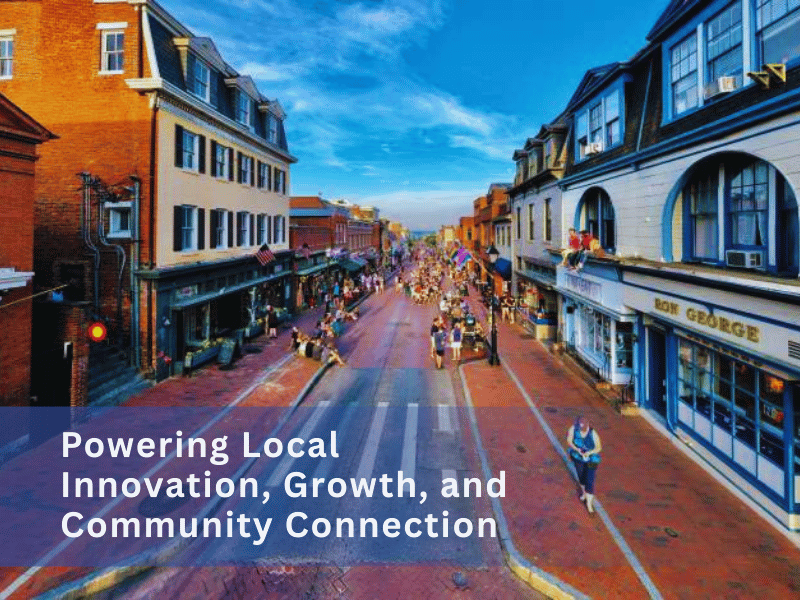
Maryland’s Digital Townsquare: Powering Local Innovation, Growth, and Community Connection
Maryland’s Digital Townsquare is one connected digital home for businesses, workforce programs, nonprofits, residents, and local government—powered by QmeLocal.
Discover resources, engage your community, and grow Maryland’s local economy together.
Built for communities. Governed locally. Scaled nationally.
Policy-Maker / Government-Focused Version
(Civic infrastructure, accountability, outcomes)
Maryland’s cities, counties, and regions face a shared structural challenge: local economic development, workforce programs, community engagement, and public communications operate across fragmented systems that limit coordination, transparency, and measurable impact.
This challenge is accelerating for three reasons:
1) Local information and trust infrastructure is weakening.
Local communities increasingly lack consistent, locally based information systems. A 2025 “State of Local News” report found 212 U.S. counties with no locally based news source and 1,525 counties with only one remaining—often a weekly outlet. At the same time, Pew reports the share of Americans who follow local news “very closely” has dropped to 22% (down from 37% in 2016).
That combination—less local information capacity and declining attention—creates a vacuum where community engagement, program participation, and civic trust become harder to sustain without a better digital approach.
2) The economy is becoming more digitally mediated—but locally uneven.
Brookings reports that in 2023, 26% of the U.S. workforce was employed in “highly digital” jobs (up from 18% in 2010 and 9% in 2002). This means the skills, tools, and systems powering economic opportunity are increasingly digital—yet local communities vary widely in how well they connect residents and small businesses to those opportunities.
3) Digital access is not the same as digital adoption.
Even where broadband is available, adoption and effective use remain gaps. Analyses of FCC-related data emphasize that deployment alone doesn’t solve affordability, adoption, and equitable access challenges.
The Maryland Digital Townsquare—powered by the QmeLocal Digital Ecosystem Engine—establishes a shared, civic-grade digital infrastructure that connects businesses, workforce systems, nonprofits, residents, and public agencies within a single, locally governed ecosystem.
Rather than replacing existing programs, QmeLocal integrates and amplifies them—creating a unified digital layer where policies, programs, and resources can be accessed, communicated, and evaluated in real time.
For policymakers, QmeLocal delivers:
-
A centralized platform for public-facing programs and services
-
Stronger cross-agency and public-private coordination
-
Improved constituent engagement and feedback loops
-
Data visibility across economic, workforce, and community initiatives
-
Scalable infrastructure without duplicative IT spend
This approach enables governments to move faster, spend smarter, and govern more transparently, while empowering local stakeholders to actively participate in shaping outcomes.
Why this direction is timely: City leaders are increasingly focused on economic and workforce development complexity. National League of Cities reporting shows local leaders continue elevating these priorities in response to changing conditions. A shared ecosystem platform reduces the “coordination tax” created when every program operates on separate tools, channels, and data.
From Fragmentation to a Single Digital Townsquare
For decades, local systems have grown independently—each program, department, or organization operating on its own platform. QmeLocal replaces this fragmentation with a single, connected Digital Townsquare that aligns stakeholders, resources, and outcomes across the entire local ecosystem.
Metrics, Outcomes, and ROI
(Funders & Partners)
Measurable Outcomes Across Economic, Workforce, and Community Systems
The QmeLocal Digital Ecosystem is designed for performance, accountability, and return on public and philanthropic investment. This isn’t “another portal.” It functions as shared infrastructure that reduces duplication and increases utilization of the programs that already exist.
A strong digital ecosystem is now essential because:
-
Small businesses are going all-in on technology, and they need local-first infrastructure to compete. A U.S. Chamber report found 99% of small businesses use at least one technology platform, and 40% self-identify as using generative AI (nearly double from 2023).
-
Small businesses plan to increase tech adoption. The same report notes 81% plan to increase their use of technology platforms.
-
Nonprofits are under pressure to modernize engagement and operations. Digital engagement has become essential for nonprofit reach and service delivery, with multiple sector reports documenting increased focus on data systems and digital engagement strategies.
-
Workforce outcomes increasingly depend on data integration across systems. A Jobs for the Future (JFF) policy brief—developed with workforce board leaders (NAWB task force)—highlights the need for data access, alignment, and integration to improve workforce outcomes.
Key Outcome Areas & Metrics
Economic Development & Business Growth
-
↑ Local business visibility and engagement
-
↑ Participation in business support and funding programs
-
↓ Time-to-resource discovery for entrepreneurs
-
↑ Local procurement and partner collaboration
Support trend: Businesses that can’t be discovered locally, can’t convert locally. Surveys show many SMBs are actively leveraging social platforms for sales and growth, signaling that local commerce is increasingly mediated through digital channels.
Workforce & Talent Development
-
↑ Enrollment in workforce training programs
-
↑ Alignment between employer demand and training supply
-
↑ Job placement and retention rates
-
↓ Fragmentation between workforce providers
Support trend: Workforce leaders are calling for stronger cross-system data and alignment to improve outcomes—exactly what ecosystem infrastructure enables.
Community Engagement & Civic Participation
-
↑ Resident participation in surveys, programs, and events
-
↑ Reach and engagement of public communications
-
↑ Trust and transparency through consistent information access
Support trend: Even as attention to local news declines, Pew finds most Americans still believe local news outlets are important to community well-being (a signal that communities value local information but need better delivery systems).
Operational ROI for Governments & Funders
-
Reduced duplication of digital tools and outreach platforms
-
Lower cost per engagement versus standalone systems
-
Shared infrastructure across agencies, cities, and partners
-
Long-term scalability without proportional cost increases
Return on Investment
QmeLocal functions as digital public infrastructure—one platform supporting multiple programs, departments, and initiatives—dramatically increasing ROI compared to single-purpose tools or isolated portals.
Why ROI improves structurally:
When programs are fragmented, governments and funders pay repeatedly for outreach, onboarding, engagement, and reporting. A unified ecosystem reduces those repeated costs by making the platform itself the “shared operating layer” for multiple initiatives (economic development, workforce, nonprofits, civic engagement).
State Agencies, Economic Development, and Workforce
A Shared Digital Infrastructure for Economic and Workforce Systems
The Maryland Digital Townsquare provides state agencies, economic development organizations, and workforce boards with a unified digital ecosystem to coordinate programs, engage stakeholders, and measure impact.
By connecting employers, training providers, job seekers, support organizations, and public agencies within one platform, QmeLocal strengthens talent pipelines, improves program alignment, and ensures resources reach the communities they are intended to serve.
This approach supports:
-
Stronger employer-driven workforce strategies
-
Increased participation in training and certification programs
-
Clear visibility into program outcomes and gaps
-
Scalable collaboration across regions and jurisdictions
QmeLocal enables Maryland’s economic and workforce systems to operate as one coordinated ecosystem, not disconnected initiatives.
Support trend: National workforce leaders have explicitly emphasized that better data alignment and integration are critical to improving outcomes—signaling that “ecosystem interoperability” is now a workforce performance requirement, not a nice-to-have.
What this means for scaling “the future of local”
This direction is not speculative—it matches the underlying trend lines:
-
Local communities need stronger local information and engagement infrastructure as local media capacity shrinks and attention fragments.
-
Small businesses are increasing use of AI and platforms; communities need local-first digital infrastructure so SMB growth doesn’t get captured only by national platforms.
-
Workforce and economic development increasingly require integrated data and coordination across organizations.
-
Digital opportunity is expanding, but local systems must be built to ensure residents and institutions can participate meaningfully.
That’s the core case: QmeLocal is the connective infrastructure layer that helps communities coordinate programs, scale engagement, and measure outcomes across stakeholders—so local growth is not fragmented, but intentionally designed.
Author: QmeLocal Digital Ecosystem Newsroom





Comments